Draft exhibit renderings from the Friends’ “Exhibit Matrix” planning deliverable ©2025 Solid Light, Inc.
The Judiciary History Center is one of the United State's first history museums created for and by a state judicial branch. Since 1989, the Center has served as a bridge between Hawaii’s Judiciary and the public, welcoming over 50,000 visitors a year.
Aliʻiōlani Hale: Place of Power, Witness to History
Aliʻiōlani Hale is the nexus of Hawaiʻi’s unique legal heritage: capitol building of the Hawaiian Kingdom, site of the overthrow of the Monarchy, and home to the Supreme Court since 1874. In the 19th century, Kānaka Maoli (Native Hawaiian) adapted western jurisprudence with traditional Hawaiian values and customs. Through this collaboration, Hawaiian Mōʻī (monarchs) established Hawaiʻi as an internationally respected, sovereign nation. The unprecedented hybrid legal structures created by the Monarchy in the 19th century distinguished Hawaiʻi from the rest of the world then, to this day.
The Judiciary History Center is intimately positioned to interpret and commemorate this legacy in our redesigned museum. Visitors will gain deeper insight into Hawaii’s history by examining changing legal systems and cultural values from the time of Hawaiian Kapu to modern civics. New narratives will engage and inspire dialogue about how Hawaiians and settlers used diverse methods and tools to shape their society. Visitors will be inspired to connect with Hawaii’s civic story, acknowledging their own role and kuleana (responsibility) to our community.
Together we can reimagine the Judiciary History Center to honor our past, inform our present, and inspire our future.
Draft exhibit renderings from the Friends’ “Exhibit Matrix” planning deliverable ©2025 Solid Light, Inc.
He Maopopo Hou o ka Moʻolelo Pohihihi
New Telling of a Complex Story
New Telling of a Complex Story
New exhibits will explore the origins and sophistication of the traditional Hawaiian Kapu system, progressive court operations of the Hawaiian Kingdom, and the ebb and flow between native and haole (foreign) power and influence in the law to this day.
Interpretive spaces will be divided into thematic zones covering diverse topics:
- Zones 1 & 2: Intro to Hawaiʻi’s Legal Heritage and the Courts Today
- Zone 3: Power Structure under Hawaiʻi’s Changing Governments
- Zone 4: Hawaiian Worldview, Land, Water, and Natural Resources
- Zone 5: Civil Rights and Citizenship Through the Centuries
- Zone 6: Oral Histories of Legislation, Public Policy, and Advocacy
Haʻina ʻia mai ana ka Puana
Tension, Emotion, Empathy, and Understanding
Tension, Emotion, Empathy, and Understanding
We will share Hawaiʻi’s civic story from the perspectives of Hawaiians and non-native settlers who made significant contributions to shaping society. The new galleries will provide an immersive visitor experience rooted in Hawaiian culture (ʻōlelo Hawaiʻi, moʻolelo, oli, and mele). Historic photographs, paintings, courthouse objects, and primary-source documents will enrich the galleries and connect the public to Hawaiʻi’s civic heritage, leaving lasting, memorable impressions.
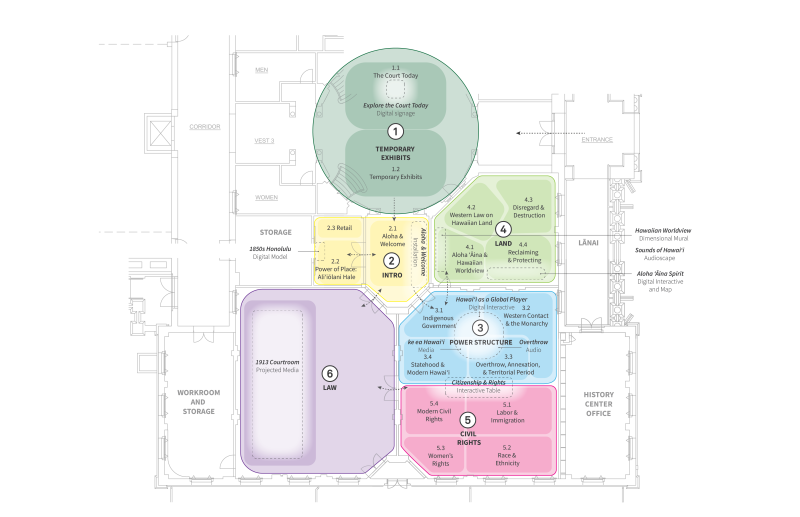
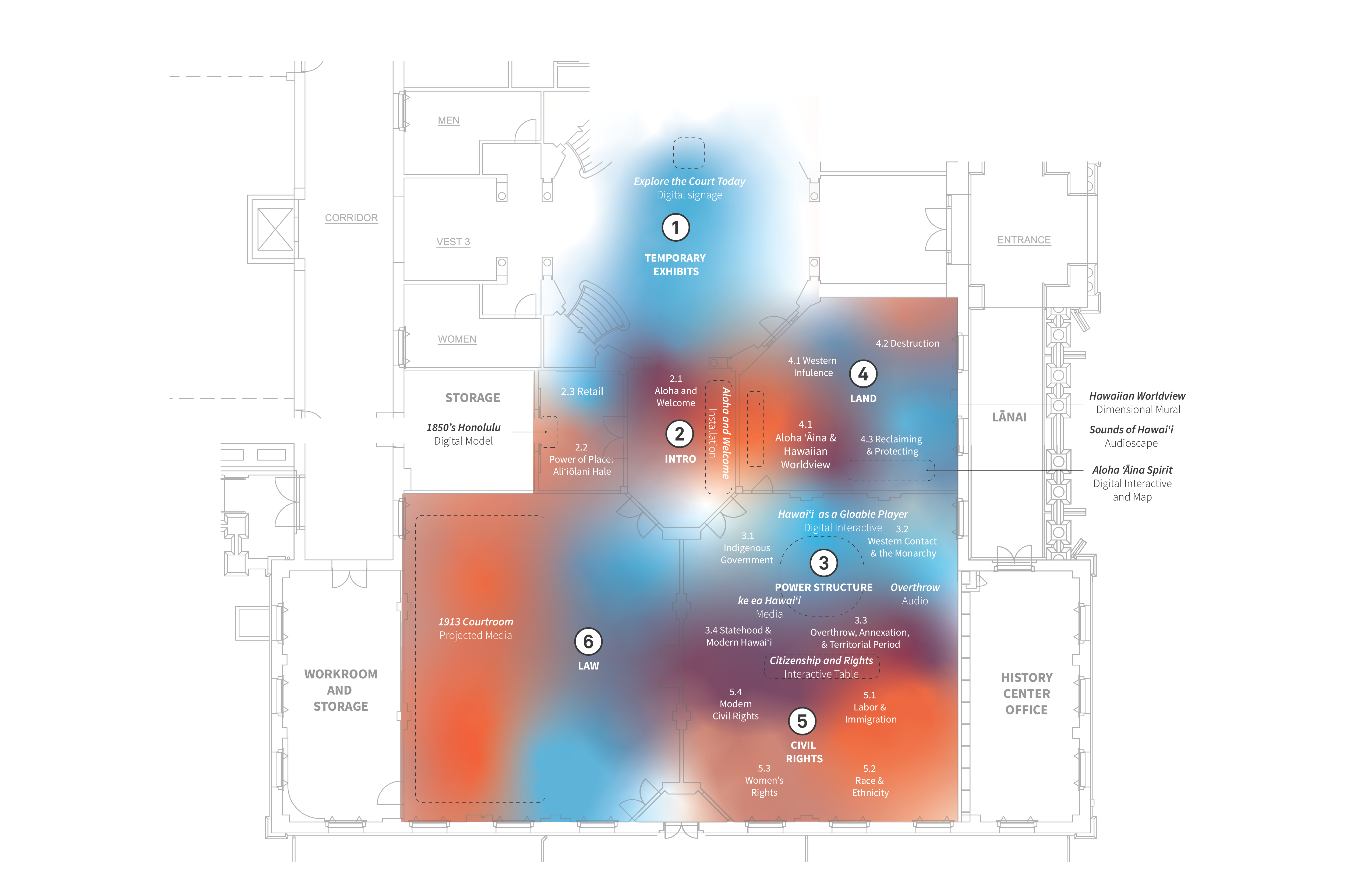
Draft exhibit floor plans from the Friends’ “Exhibit Matrix” planning deliverable outlining placement of themes ©2023 Solid Light, Inc.
Your generous contributions will help us fulfill an ambitious yet critical phase of this project: renovating our infrastructure in Aliʻiōlani Hale—preserving this beloved landmark and nationally registered historic site, ensuring Aliʻiōlani Hale and the Judiciary History Center remain valued community resources.

The Judiciary History Center’s museum redesign project is made possible in part by funding to the Friends of the Judiciary History Center of Hawaiʻi from the Institute of Museum and Library Services [award# MN-256130-OMS-2]. The views, findings, conclusions or recommendations expressed in this website do not necessarily represent those of the Institute of Museum and Library Services.